Vision Zero on Two Wheels Webinar Explores What a Safe System Means for Motorcyclists
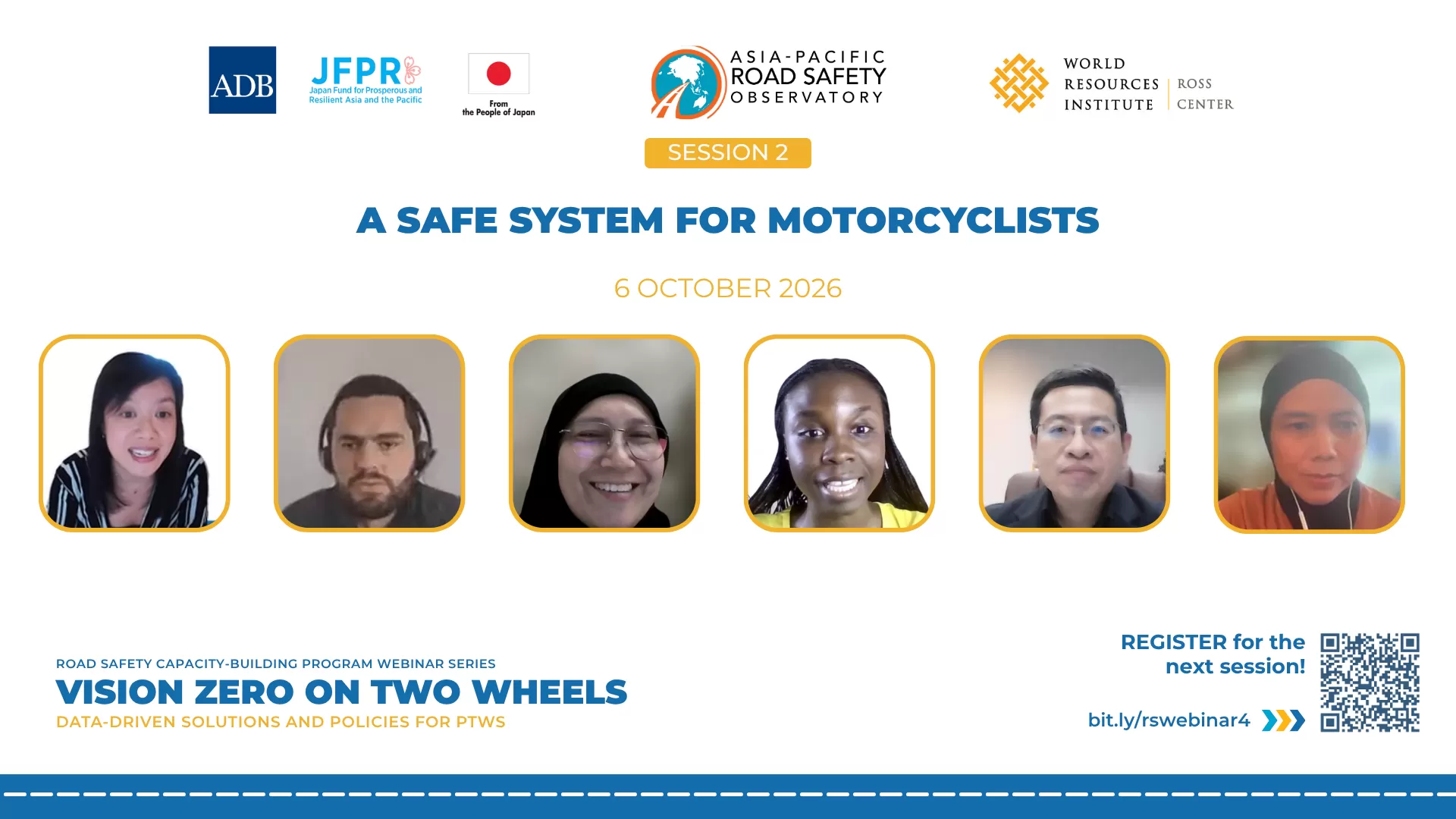
On 6 October 2026, the Asia Pacific Road Safety Observatory (APRSO) and the Asian Development Bank (ADB) convened the second session of the four-part webinar series, Vision Zero on Two Wheels: Data-Driven Solutions and Policies for Powered Two-Wheelers (PTWs). The session, titled What Does a Safe System Look Like for Motorcyclists?, brought together road safety experts and practitioners to explore how Safe System principles can better protect motorcycle riders while supporting the mobility needs of communities across Asia and the Pacific.
Co-presented in partnership with the World Resources Institute (WRI) Ross Center for Sustainable Cities, the webinar series is supported by a grant from the Japan Fund for Prosperous and Resilient Asia and the Pacific (JFPR), financed by the Government of Japan through ADB.
Moderated by Dr. Jessica Truong, Director of Lösningar, the session opened with an introduction to a research project examining what a Safe System for motorcyclists should look like in practice. Presenting findings developed with an international panel of experts, Dr. Truong highlighted the importance of designing transport systems around both riders' mobility needs and the limits of human tolerance to crash forces. She noted that safer outcomes depend on combining speed management, infrastructure design, vehicle technologies, and policy in a coordinated way, rather than relying on any single intervention.
Segundo López, Research and Program Manager at the World Resources Institute, explored how infrastructure can help reduce motorcycle deaths and serious injuries. Drawing on research from multiple cities and implementation experience in Bogotá, Colombia, he highlighted the critical role of speed management, safer intersections, improved median treatments, and corridor-wide approaches to road safety. He also shared examples of low-cost infrastructure measures that have delivered substantial reductions in motorcycle fatalities.
Turning to vehicle safety, Salina Mustaffa of the Malaysian Institute of Road Safety Research (MIROS) presented regional efforts to improve motorcycle safety through consumer-focused assessment programmes. She introduced initiatives such as the Malaysian Motorcycle Assessment Program (MyMAP), ASEAN Motorcycle Assessment Program (ASEAN MAP), and ASEAN New Car Assessment Programme's (NCAP's) motorcycle safety pillar, which aim to encourage manufacturers to adopt safer technologies while providing consumers with better information on motorcycle safety performance.
Oliva Nalwadda, Regional Coordinator for Africa at the FIA Foundation, focused on the policy dimension of the Safe System approach. She emphasized that while evidence on effective motorcycle safety interventions already exists, the challenge lies in translating that evidence into regulations, standards, and long-term implementation plans. Using examples such as helmet standards and motorcycle anti-lock braking systems (ABS), she outlined how governments can move successful pilot initiatives into national policy and scale them for lasting impact.
Providing a city-level perspective, Sayan Thasanakosol, Director of the Traffic Engineering Office at the Bangkok Metropolitan Administration, shared Bangkok's experience implementing Vision Zero principles to address motorcycle fatalities. He presented a range of measures being deployed across the city, including dedicated motorcycle lanes, safer bridge and tunnel treatments, improved lighting, and protected turning facilities. His presentation demonstrated how data-driven interventions can be used to target high-risk locations while supporting safer travel for all road users.
Throughout the discussion, speakers highlighted a common message: improving motorcycle safety requires a holistic Safe System approach that brings together infrastructure, vehicle safety, policy, enforcement, and data. While motorcycles play a vital role in providing access to jobs, services, and economic opportunities, reducing rider trauma will require transport systems that are designed to protect people when mistakes occur.
The Vision Zero on Two Wheels webinar series continues through October and November 2026. Read about the series here.
Session recordings, presentations, and related resources will be made available through the APRSO Knowledge and Innovation Hub.