Keeping Two-Wheeler Journeys Safe: Highlights from the Third Session in Latest Webinar Series
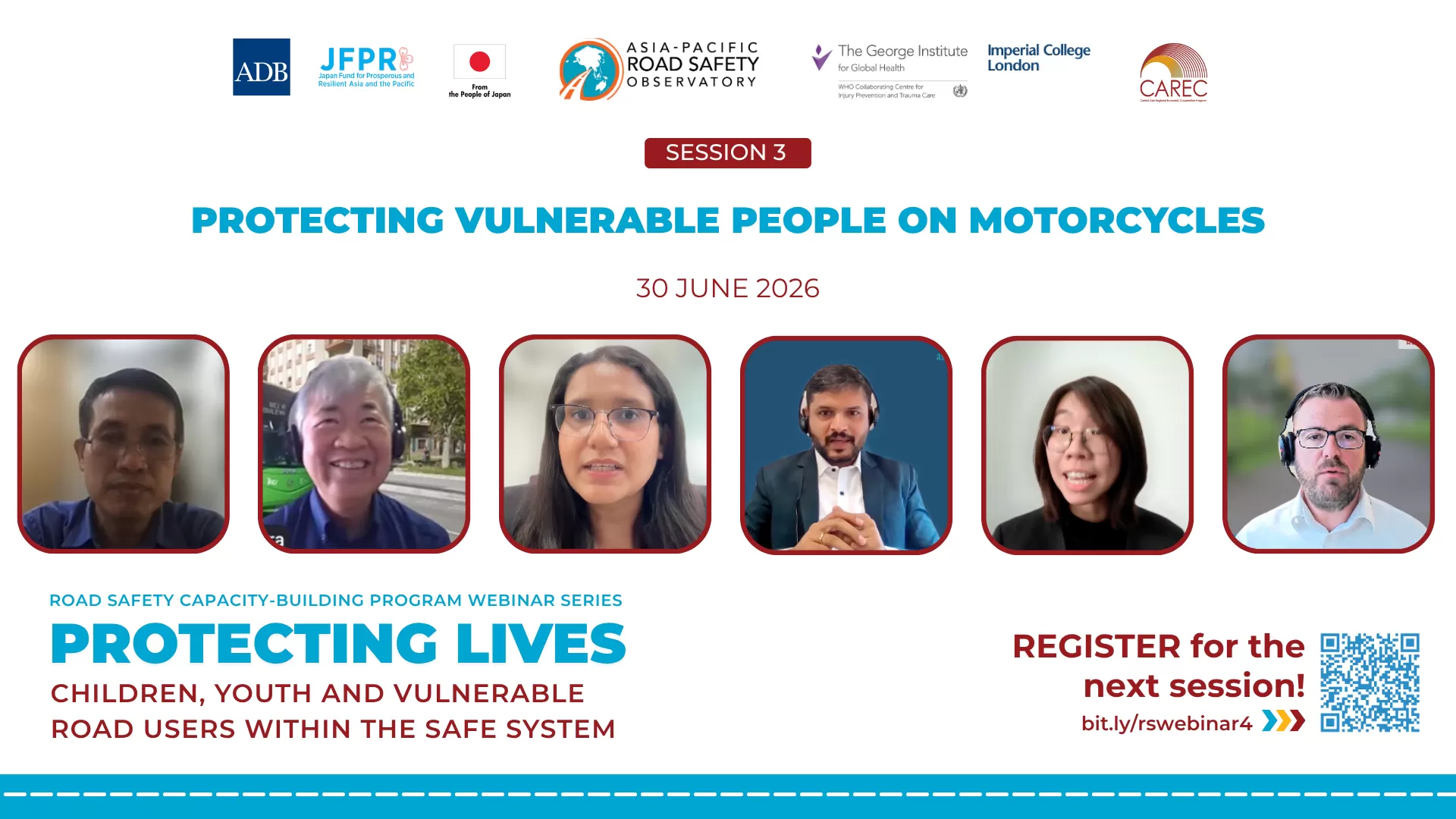
The "Protecting Lives: Children, Youth, and Vulnerable Road Users within the Safe System" webinar series resumed on 30 June 2026. The third session in the series focused on one of the most common—and most vulnerable—forms of transport across Asia and the Pacific: motorcycles. Bringing together experts from academia, international organizations, industry, and civil society, the session explored why motorcycles remain central to mobility for millions of people and what it will take to make those journeys safer.
The webinar series is supported by a grant from the Japan Fund for Prosperous and Resilient Asia and the Pacific (JFPR), financed by the Government of Japan through ADB.
Setting the scene, Cuong Pham from the Hanoi University of Public Health highlighted the reality that two- and three-wheelers dominate transport across much of Southeast Asia, where motorcycles are not merely a transport option but a reality for children, older adults, and the growing number of gig economy workers. Yet this reliance comes with significant risks, particularly when factors such as speeding, distraction, alcohol use, and low rates of protective equipment are combined with the limited physical protection that motorcycles provide.
Looking at the broader regional picture, Adwait Limaye from the Asian Transport Observatory presented data showing a concerning mismatch between transport realities and infrastructure design. While Southeast Asia remains one of the world's most motorcycle-dependent regions, only a small share of roads provide infrastructure that meets key safety thresholds for motorcyclists.
The discussion then shifted from challenges to solutions. Professor Fumihiko Nakamura from the Open University of Japan and the International Association of Traffic and Safety Sciences (IATSS) shared examples of collaborative road safety initiatives in Cambodia and Thailand that brought together governments, development partners, educators, industry, and communities. He highlighted the value of building a culture of safety through education, practical training, and partnerships, and emphasized the importance of evaluating whether such efforts lead to lasting changes in behaviour.
Adding a private-sector perspective, Megha Singh from Uber described how motorcycle taxis have become an increasingly important part of urban mobility, particularly for first- and last-mile connections to public transport. Apart from sharing about Uber Moto, a motorcycle taxi service, she spoke about how technology platforms can contribute to safer journeys through driver training, helmet verification, safety education for riders, and in-app features designed to identify and respond to potential safety concerns.
Closing the session, Khe Nguyen from AIP Foundation shared lessons from Thailand's efforts to improve helmet use. The case study found that the challenge extends beyond legislation alone. Effective enforcement, stronger helmet standards, improved market oversight, and greater public awareness all emerged as critical elements for increasing helmet use and reducing injuries.
The session showcased that solutions to address motorcycle fatalities and injuries involve safer roads, safer behaviour, stronger institutions, better vehicles and equipment, informed policy, and multisectoral collaboration—all of which must be addressed by Asia and the Pacific, where people will continue to rely on motorcycles for mobility and livelihoods.
The webinar series will continue with its fourth and final session scheduled for 7July 2026. Read more about the upcoming sessions here.