"Protecting Lives" Final Webinar Session Focuses on Safe Journeys to Schools and Public Spaces
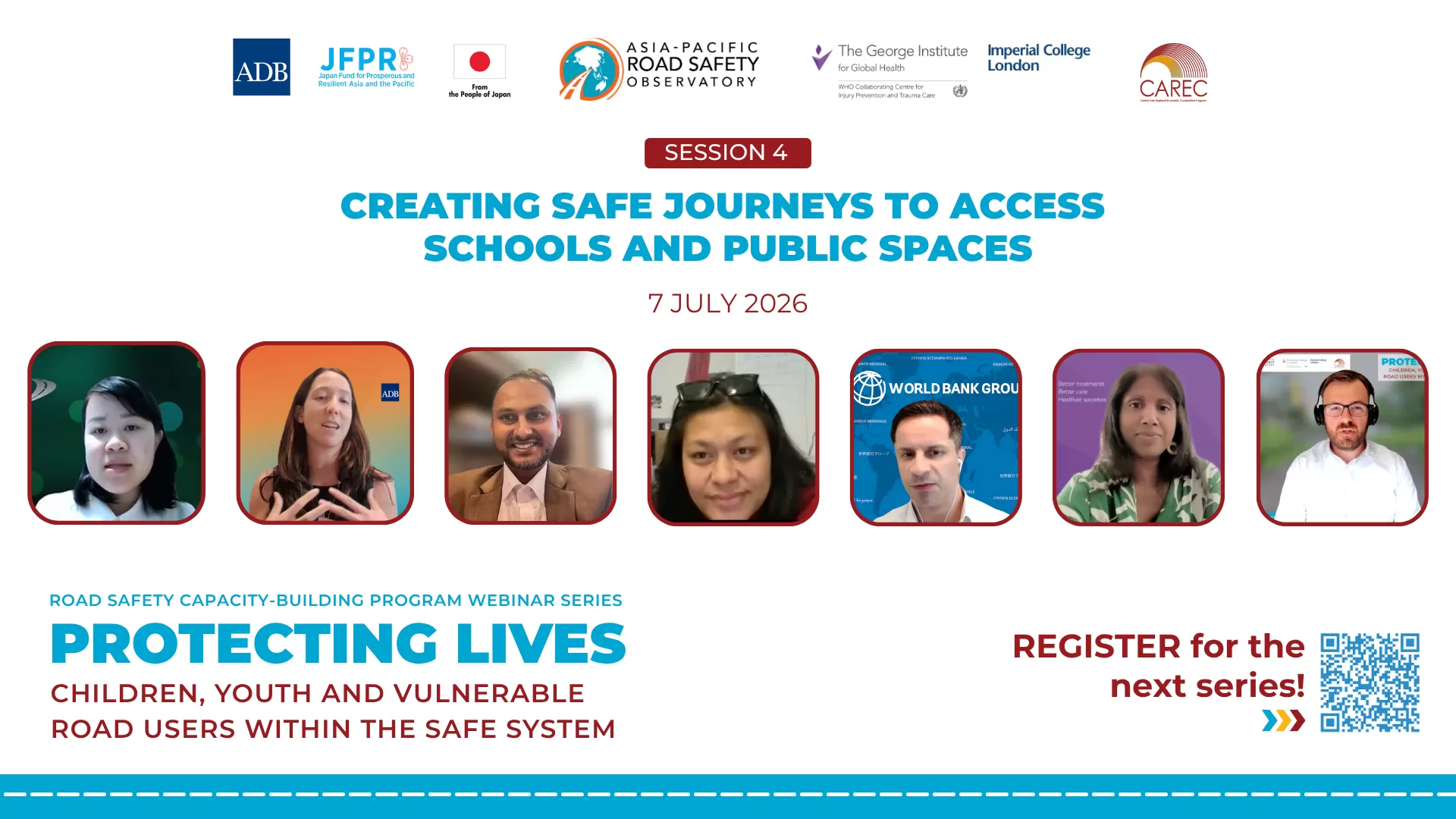
On 7 July 2026, the Asia Pacific Road Safety Observatory (APRSO) and the Asian Development Bank (ADB) concluded the four-part webinar series “Protecting Lives: Children, Youth, and Vulnerable Road Users within the Safe System” with its final session, “Creating Safe Journeys to Access Schools and Public Spaces.”
Co-presented in partnership with The George Institute for Global Health and the Central Asia Regional Economic Cooperation (CAREC) Program, the session brought together experts and practitioners from across the region to share practical approaches to improving safety around schools, public spaces, and the routes that connect people to them.
The webinar series is supported by a grant from the Japan Fund for Prosperous and Resilient Asia and the Pacific (JFPR), financed by the Government of Japan through ADB.
Moderated by Blaise Murphet, the session focused on how Safe System principles can be applied to create safer environments for children, youth, and other vulnerable road users.
Minh Vo, Sustainable Mobility Coordinator at iRAP, opened the session by outlining the Safe System requirements for school zones and access to public spaces. She highlighted the importance of combining safe speeds, road design, infrastructure, enforcement, and public awareness to create environments that better protect children, and drew on examples from Viet Nam among other international references.
Claire Charamnac of ADB then explored the links between gender, mobility, and road safety. She highlighted how women and men experience transport systems differently and introduced ADB’s Gender Equality in Transport Toolkit, an interactive resource designed to help practitioners better integrate gender considerations into transport planning, project design, and road safety initiatives.
Building on these themes, Hemant Tiwari of ADB shared lessons from Nepal’s application of the iRAP Star Rating for Schools methodology across rural road projects. Assessments of 14 schools identified significant safety risks, but relatively low-cost interventions—including improved signage, speed management measures, pedestrian crossings, rumble strips, and visibility improvements—were able to substantially improve safety ratings.
Christina Wanganui from Samoa’s Ministry of Works, Transport and Infrastructure presented the country’s efforts to improve safety through better data and coordinated action. She highlighted Samoa’s national crash database system, ongoing investments in pedestrian infrastructure and safer school zones, and efforts to embed accessibility and inclusion within broader road safety planning. A key message from her presentation was the value of strong partnerships across government agencies in delivering safer outcomes for communities.
Representing the World Bank, Clemens Portenlaenger shared examples from India, Cambodia, and Kiribati, demonstrating how practical infrastructure improvements can make a meaningful difference around schools. From safer crossings and waiting areas to tactical urbanism projects developed with local communities, the case studies illustrated how relatively simple and affordable interventions can significantly improve safety while building local ownership and support.
In closing remarks, Prasanthi Attwood of The George Institute for Global Health reflected on the key themes that emerged throughout the webinar series. She noted that many of the solutions needed to save lives are already well understood—from safer speeds and crossings to stronger legislation and better road design. The challenge now is ensuring these solutions are translated into policy, budget decisions, and implementation on the ground.
The session marked the conclusion of the four-part webinar series, which brought together experts from government, academia, development organizations, civil society, and the private sector to explore practical approaches to protecting children, youth, and vulnerable road users within the Safe System.
Session recordings, presentations, and supporting resources from this session and the full webinar series are available through the APRSO Knowledge Hub through this link.