APRSO, ADB, and WRI Ross Center for Sustainable Cities Launch New Webinar Series on Powered Two-Wheeler Safety
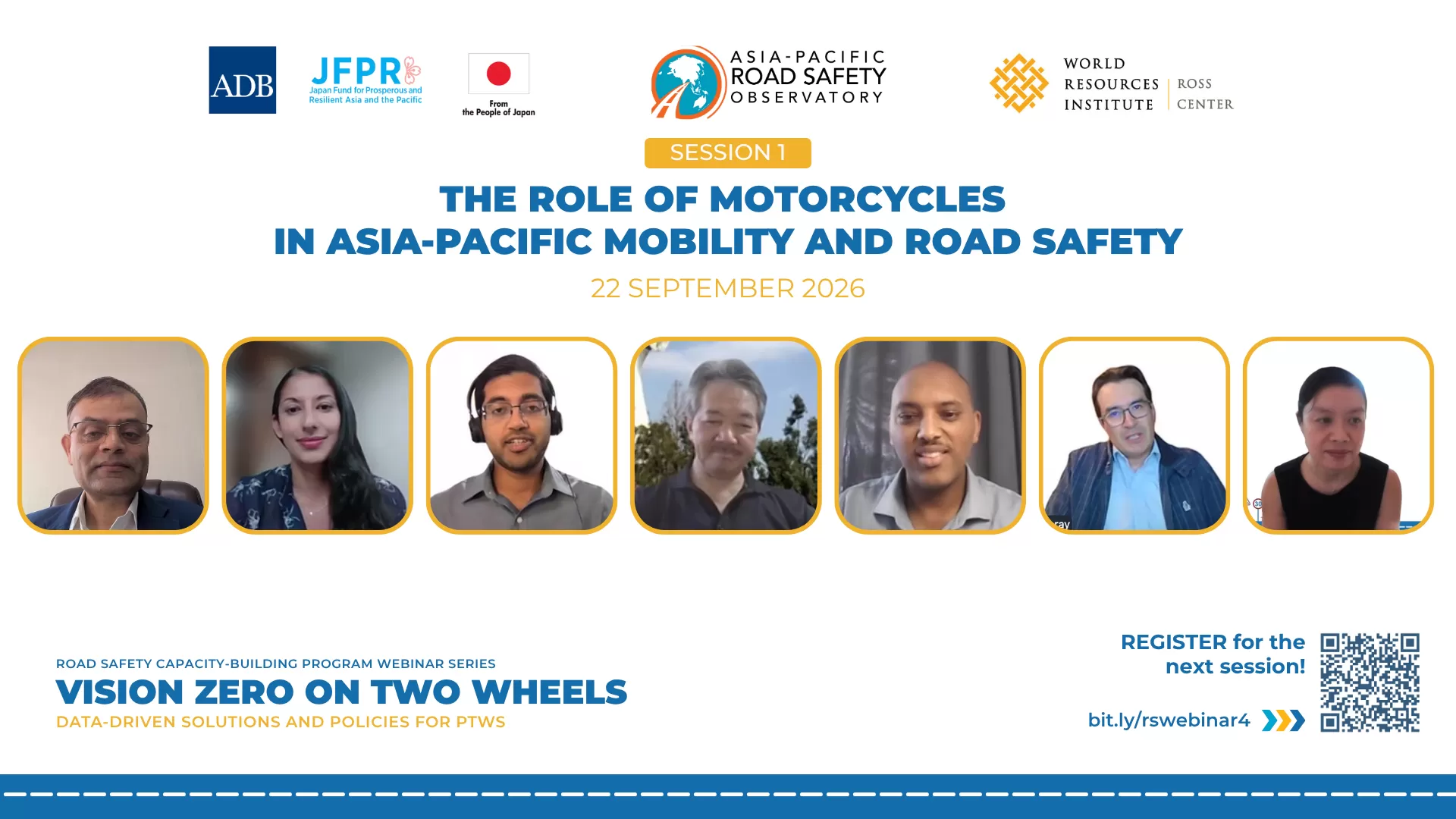
On 22 September 2026, the Asia Pacific Road Safety Observatory (APRSO) and the Asian Development Bank (ADB) launched the four-part webinar series Vision Zero on Two Wheels: Data-Driven Solutions and Policies for Powered Two-Wheelers (PTWs) with its opening session, Understanding the Powered Two-Wheeler Challenge in Asia and the Pacific.
Co-presented in partnership with the World Resources Institute (WRI) Ross Center for Sustainable Cities, the session convened 155 participants from across Asia-Pacific and beyond, bringing together experts from Asia-Pacific, Africa, and Latin America to examine the growing challenge of motorcycle safety and explore how Safe System approaches can better respond to the realities of motorcycle-dependent transport systems. The webinar series is supported by a grant from the Japan Fund for Prosperous and Resilient Asia and the Pacific (JFPR), financed by the Government of Japan through ADB.
Moderated by Jessica Truong of Lösningar, the session opened with remarks from APRSO Steering Committee Chairperson Sushil Dhakal, who reflected on the central role motorcycles play across many member countries. He shared that for millions of people across the region, motorcycles are not simply a mode of transport but a vital link to work, education, healthcare, and economic opportunity. At the same time, he noted that riders account for a disproportionate share of road deaths across the region, making PTW safety a critical priority for APRSO and its members.
Priti Gautam, Senior Transport Specialist and Road Safety Lead at ADB, then outlined the scale of the challenge across Asia and the Pacific, where motorcycles represent nearly half of all registered vehicles and account for the highest share of road fatalities among road user groups. She emphasized that lasting progress will require a broader Safe System approach that better protects riders when mistakes occur.
Representing WRI, Vineet John explored the concept of motorcycle-dependent transport systems and the difficult trade-offs many countries face. He highlighted how motorcycles have transformed access to jobs, markets, and essential services, particularly for lower-income communities and those living beyond the reach of reliable public transport. At the same time, he warned that when motorcycles become the only practical mobility option, rising road trauma can become an unintended cost of development.
Professor Kenji Doi of Osaka University and the International Association of Traffic and Safety Sciences (IATSS) focused on the role of safety culture in shaping rider behaviour. Drawing on research from Southeast Asia and community-based programs in Cambodia and Bhutan, he highlighted how long-term education and engagement can help safer choices become habitual, creating a culture that supports safer riding for individuals, families, and communities.
Providing perspectives from other regions, Yonas Bekele of the African Road Safety Observatory examined the rapid growth of motorcycle transport across Africa, noting how motorcycles have filled critical mobility gaps while also creating complex safety and governance challenges. Jean Pol Armijos Leray of the Inter-American Development Bank then shared lessons from Latin America and the Caribbean, where motorcycle deaths have risen sharply alongside growing fleets. He highlighted evidence-based approaches ranging from helmet standards and rider training to safer infrastructure and stronger institutional coordination.
During the discussion session, speakers reflected on a common theme emerging across regions: motorcycles provide enormous social and economic benefits, but reducing rider trauma will require systems that protect people without compromising access to mobility.
The session marked the beginning of the four-part Vision Zero on Two Wheels webinar series, which will continue through November 2026 and explore practical approaches to improving powered two-wheeler safety across the region. Sign up for the series here.
Session recordings, presentations, and supporting resources from this session will be made available through the APRSO Knowledge Hub.